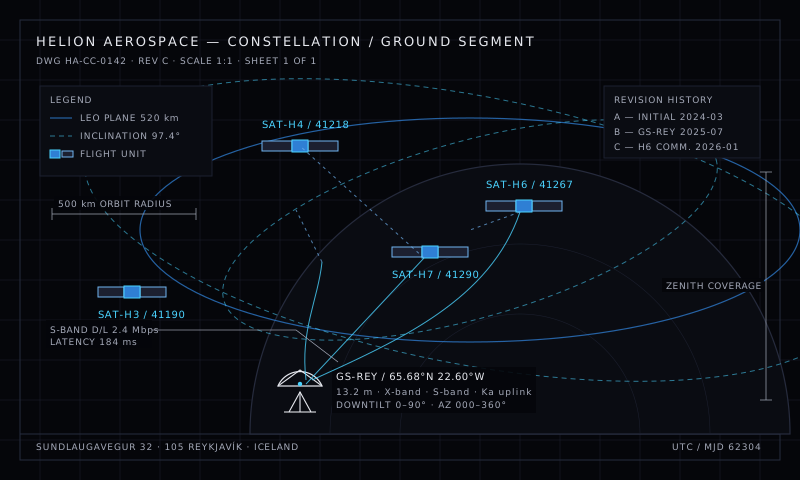
Helion Aerospace runs the ingest, decoding and planning layer for small satellite operators. Connect a ground station, keep every packet addressable, and let Mission Control schedule the passes your spacecraft actually gets.
Telemetry Hub moves the bytes. Mission Control decides who talks to the spacecraft and when. Both read the same spacecraft registry, so a pass planned in the browser is the same pass the ingest pipeline reserves bandwidth for.
Ingests CCSDS transport frames and Space Packet Protocol payloads from any station, decodes them against your mission dictionary, and stores them as addressable CDF, CSV or Parquet objects. Retries are idempotent, gaps are recorded rather than hidden, and every archive is queryable with the same SQL you would write against a warehouse.
Holds the schedule: contact windows computed from your propagator of choice, uplink command queues, downlink priority, and the alert rules that decide who gets woken up. Roles, audit trails and approval gates are built in, because a spacecraft operator with one person and one satellite still needs a change log.
Three steps, no proprietary format in the middle. Everything Helion stores can be exported raw, and every raw frame we accept is retrievable byte for byte.
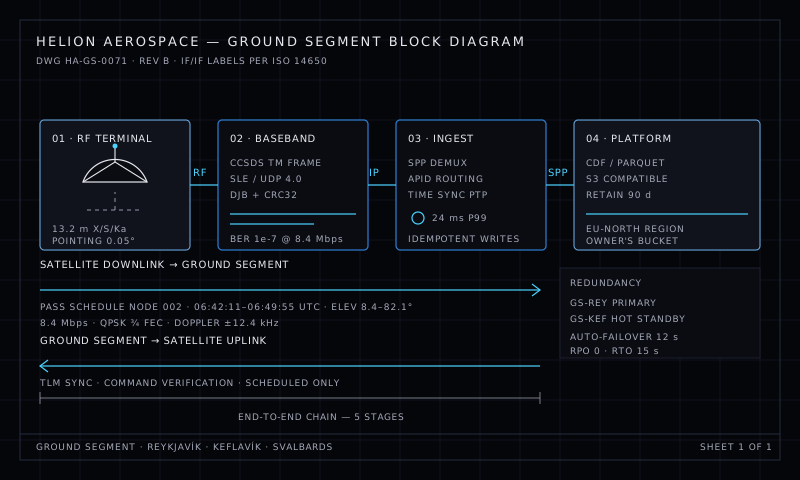
A ground station streams transport frames over the SLE or UDP link it already uses. Helion accepts a station key, authenticates it with mutual TLS, and opens a stream within one round trip. Nothing needs to be reconfigured on the antenna side.
The primary header, the secondary header and the payload are split apart. A packet's APID, sequence counter and source spacecraft are resolved against the mission dictionary you registered, so a parameter lands in the right table with the right units.
Decoded values are committed to a columnar store and the raw frame is written to object storage. Queries hit the columnar copy; the raw frame is the record of truth, retained for 90 days on every plan and longer where you need it.
Telemetry Hub does not ask you to change how you build a spacecraft. Frames arrive as they leave the antenna. If you already emit CCSDS space packets with a PUS-like secondary header, the APID map in your mission dictionary does the rest. If you emit something older, an ingest adapter converts it at the edge, and the conversion is logged.
Every write is validated before it is committed. A frame whose CRC fails is rejected with a reason code, a frame whose sequence counter jumps is stored and flagged as a gap, and a frame whose APID is not in the dictionary is written to an unmapped bucket rather than dropped. Operators in the field have lost enough data to silence to know that dropped frames are worse than flagged ones.
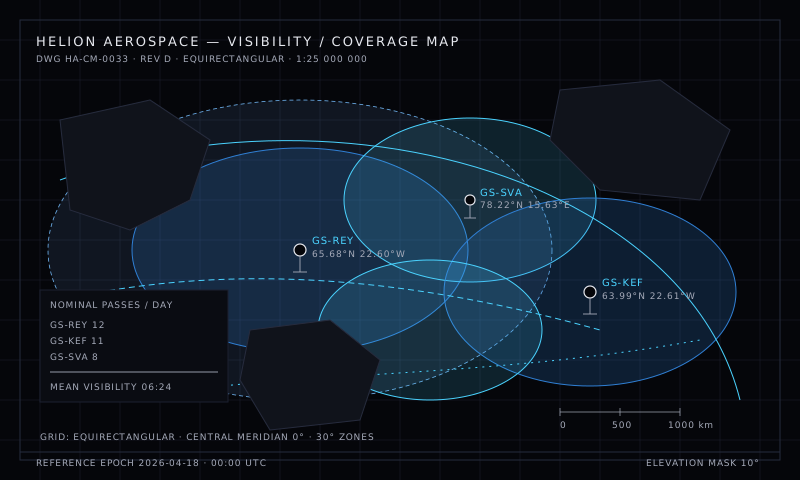
Every Helion plan includes the full contact window catalogue for the included ground segments. Windows are computed per station from a propagated ephemeris and are re-published whenever the orbit model changes, so a pass that moved by forty seconds in the morning is not a surprise in the evening.
For operators flying outside the included footprint, the same window model runs against your own passes: upload an ephemeris file, pick the stations you have access to, and Helion computes acquisition of signal, loss of signal and the usable arc in between. Overlapping arcs are shown as separate windows because a 4.2-degree overlap at the horizon is not two usable passes, it is one pass with a disputed boundary.
The platform runs on the same code paths in production that we exercise in testing, including the failure cases.
A replayed frame with the same spacecraft, APID and sequence counter is recognised and dropped at the edge. Retries after a network partition never produce duplicate parameter samples.
Decoded values live in a columnar store for query speed. The untouched transport frame lives in object storage as the authoritative copy, so a decoder bug is fixable without a second pass of the spacecraft.
Contact windows are computed from the elements you upload, at the stations you name, with your elevation mask applied. Nothing is estimated from a nominal orbit unless you ask for a nominal orbit.
Owner, operator, viewer and automation roles with per-spacecraft grants. Command approval can require a second person for anything marked critical, and every grant change is written to an audit log.
Rules are written against decoded parameters with units attached, not against raw frame counts. A rule that says "battery bus voltage below 27.4 V" behaves the way an engineer expects it to behave.
CDF, CSV and Parquet exports to any bucket you control, on a schedule or on demand. There is no export fee and no throttling on bulk retrieval for operators on an annual plan.
Bring one spacecraft, one station and one week of frames. We will show you the decoded telemetry and the contact windows before you commit to anything.
What a full year of aggregate ingest telemetry says about battery margins, downlink budgets and the pass windows operators actually use.
How the primary and secondary headers are split, how APID maps are resolved, and why gaps are recorded instead of silently dropped.
A practical method for turning an ephemeris and a station list into a downlink schedule that survives a missed pass.